Bitcoin's Identity Crisis
Bitcoin's Identity Crisis
Date: 23 Feb 2026
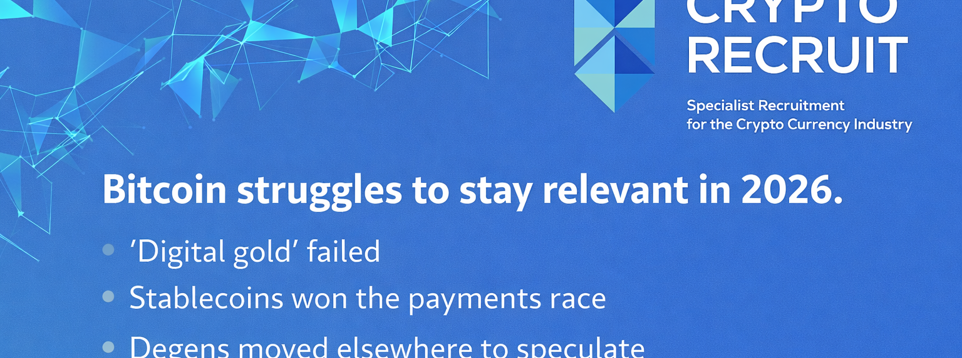
Bitcoin got everything it wanted. And it still wasn't enough.
Down 40% from its peak. Trading below $68,000. ETF outflows hitting $3.8 billion. The Fear & Greed Index at 14 "Extreme Fear" territory.
But here's the thing: This isn't a regulatory crackdown. It's not an exchange collapse. It's not even a liquidity crisis.
This is an existential crisis. And the HODL crowd doesn't want to admit it.
The Three Narratives That Just Died
For over a decade, Bitcoin believers clung to three core stories:
"It's digital gold." A hedge against inflation. A safe haven when markets panic. The macro bet for when fiat fails.
"It's the future of payments." Peer-to-peer cash. Permissionless money. The payment rail that bypasses banks.
"It's the ultimate speculation." The asymmetric bet. The casino for the internet-native. Where fortunes are made overnight.
In February 2026, all three narratives collapsed. Simultaneously.
When the Fed signaled tighter policy and equity markets crashed on January 29, gold rallied to $5,500. Bitcoin? It dropped 15% in a single day, from $96,000 to $80,000.
Digital gold is supposed to move opposite to risk assets during crises. Bitcoin moved with them. The correlation between Bitcoin and gold turned negative for the first time: -0.27. When gold surged 3.5%, Bitcoin crashed 15%.
If Bitcoin is digital gold, it failed its most basic test.
Stablecoins Won the Payments War (And Nobody Noticed)
Remember when Jack Dorsey was a Bitcoin maximalist?
In November, his Cash App announced support for stablecoins. Not Bitcoin. Stablecoins.
For years, Dorsey preached Bitcoin-only doctrine. His pivot wasn't subtle, it was a signal that the payments race had moved on without Bitcoin.
Washington agrees. The GENIUS Act passed with bipartisan support, establishing federal frameworks for stablecoins. Regulators are openly encouraging dollar-backed token infrastructure. Visa expanded USDC settlement into its core operations.
Carlos Domingo, CEO of tokenization platform Securitize, said it plainly: "Stablecoins are for payments. I don't think anyone today sees Bitcoin as a payment mechanism."
The irony? Bitcoin was designed as peer-to-peer electronic cash. Satoshi's whitepaper literally says "Bitcoin: A Peer-to-Peer Electronic Cash System."
But in 2026, if you want to send value instantly, cheaply, and reliably across borders, you're using USDC or USDT. Not Bitcoin.
Prediction Markets Are the New Casino
The dopamine chasers who once flipped memecoins? They're on Polymarket now.
Prediction markets: Polymarket, Kalshi, and others, are siphoning speculative capital that used to flow into crypto. Binary outcomes. Real-world stakes. Rapid settlement. It's everything degens loved about crypto trading, with actual utility.
Platform volumes are exploding. Some prediction markets are now processing billions in weekly volume. And unlike leveraged Bitcoin trades that get liquidated in cascading crashes, prediction markets settle on verifiable real-world events.
As Noelle Acheson, author of Crypto Is Macro Now newsletter, put it: "New speculative venues like prediction markets are siphoning attention from crypto. Bitcoin is a 'macro asset' now, competing with alternatives that are easier to understand and easier to explain to trustees, clients, your board."
Translation: The smart money found more defensible places to gamble.
The HODL Cope Isn't Working Anymore
Every Bitcoin crash brings out the same defenses:
"Zoom out." "We've been here before." "Weak hands." "Buy the dip." "21 million cap." "Four-year cycle."
And historically, they've been right. Bitcoin has crashed badly at least four times. Each time, it recovered. Each time, the HODLers were vindicated.
But something fundamental changed in 2026.
Bitcoin's correlation with the Nasdaq surged from 0.15 in 2021 to 0.75 in January 2026. Its volatility now moves in lockstep with stock market volatility, correlation of 0.88 with the VIX, the highest ever recorded.
This isn't Bitcoin acting like a unique asset. This is Bitcoin acting like a leveraged tech stock. And if Bitcoin is just a leveraged bet on Nasdaq, what's the point? Why not just buy QQQ and accept lower volatility?
The digital asset treasury model, MicroStrategy and others hoarding Bitcoin and issuing shares against it was supposed to be Bitcoin's corporate identity. Instead, many of these companies now trade below the value of their Bitcoin holdings. The model broke.
The Uncomfortable Truth About Infrastructure
Here's where it gets weird.
Everything Bitcoin advocates wanted happened. Institutional adoption? Check. ETFs from BlackRock and Fidelity? Check. Regulatory clarity? Getting there. Wall Street integration? Fully operational.
Bitcoin became everything it was supposed to become. And the result? It lost its mystique.
What once required falling down a rabbit hole of libertarian economics, cryptography, and Austrian monetary theory now takes a brokerage login and two clicks. Bitcoin went from cypherpunk resistance to a ticker symbol in a dropdown menu.
The infrastructure Bitcoin needed to go mainstream is the same infrastructure that made it boring.
And boring doesn't command $100K prices and global narratives about revolutionary money. Boring trades at fair value based on supply, demand, and correlation to other assets.
What Actually Matters Now
So is Bitcoin dead? No.
Is the HODL-through-anything mentality still valid? That's the question nobody wants to answer honestly.
Bitcoin still has the deepest liquidity of any digital asset. It has the most established network effects. Spot ETFs made it a permanent fixture in portfolios. And regulatory clarity, the thing that's helping stablecoins will ultimately benefit the entire ecosystem.
But survival and relevance aren't the same thing.
Bitcoin's biggest threat isn't a competitor or a crash. It's drift. A slow loss of attention, capital, and belief when no single narrative can sustain it.
The asset still exists. The network still runs. But the stories that gave Bitcoin its allure, digital gold, free money, institutional reserve, speculative edge are crumbling simultaneously.
The Fork in the Road
Bitcoin has four possible paths forward in 2026:
Path 1: Digital Gold (For Real This Time) Governments and corporations treat it like gold reserves. They buy and never sell. Volatility becomes irrelevant. Success measured in decades.
Path 2: Commodified Risk Asset Institutions formally classify Bitcoin as a high-volatility commodity. Everyone agrees it's not a hedge, it's a leveraged bet on monetary expansion. Position sizing adjusts.
Path 3: Speculative Appendix Bitcoin becomes a niche asset for libertarians and offshore markets. Institutional interest fades. Stablecoins dominate payments. Prediction markets dominate speculation. Bitcoin trades on sentiment alone. Price: Who knows.
Path 4: The Hybrid Bitcoin finds purpose as collateral for DeFi, cross-border settlement for large transactions, and a neutral reserve asset for protocols. Not sexy. Actually useful. Price stabilizes based on utility, not narrative.
Which path wins depends on what happens in the next six months.
What This Means for Builders and HODLers
If you're building in crypto right now, the lesson is clear: Narrative isn't enough.
Stablecoins won because they solve a real problem (payments) better than Bitcoin. Prediction markets are winning speculation because they offer clear utility beyond pure price movement.
Bitcoin's challenge isn't technical. It's philosophical. What is it for?
For HODLers, the question is harder. Do you believe Bitcoin will reclaim one of its narratives? Do you think a new narrative will emerge? Or are you holding out of conviction that's disconnected from reality?
History shows Bitcoin is resilient. But history also shows that assets can survive without being relevant. MySpace still exists. So does Yahoo. Survival doesn't mean dominance.
The Bottom Line
February 2026 forced Bitcoin to answer a question it's avoided for 15 years: If it's not the best hedge, the best payment rail, or the best speculation, what is it?
The market is deciding in real-time. Gold is winning the hedge argument. Stablecoins are winning payments. Prediction markets are winning speculation.
That doesn't mean Bitcoin is finished. It means Bitcoin's era of being all things to all people is over.
The projects that survive and thrive in crypto going forward will be the ones with clear, defensible use cases. Not aspirational narratives. Not ideological purity. Just utility that holds up under pressure.
Bitcoin has utility. The question is whether that utility justifies $68K, $100K, or $150K per coin or whether the market is still pricing in narratives that no longer exist.
The HODLers who refuse to ask that question are the ones who'll get hurt worst.
The ones willing to look honestly at what Bitcoin is versus what they want it to be? They'll make better decisions. Whether that means holding, selling, or just recalibrating expectations.
Because in 2026, "zoom out" and "21 million cap" aren't answers anymore.
They're cope.
Ready to hire smart — or be hired into something big?
Let’s talk. HERE
No fluff. No filters. Just honest recruiting in Web3.
Still struggling to stand out?
Neil offers one-on-one career consultations to help you get clear, get seen, and get hired. HERE
Looking for a job? Reach out to us HERE
Back to News Share to LinkedIn
 Share to Twitter
 Share to Facebook
 Back to news