We Called It in January. Here's What Actually Happened
We Called It in January. Here's What Actually Happened
Date: 04 May 2026
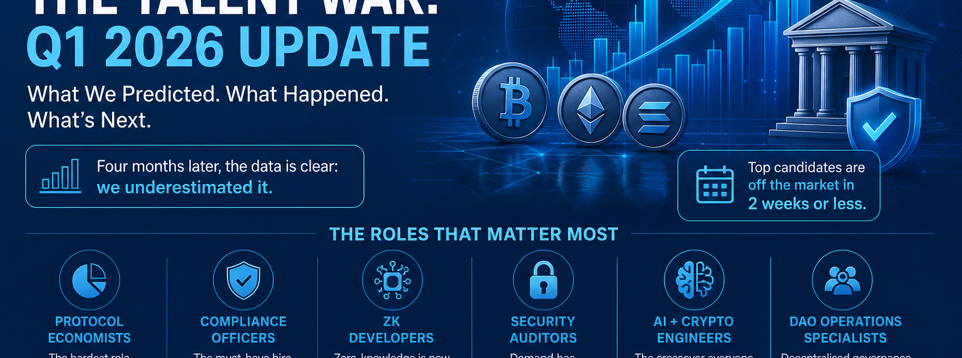
In January, we wrote that the talent war was on. That the GENIUS Act had changed everything. That Protocol Economists and Compliance Officers were becoming the most valuable people in crypto. That top candidates would be off the market in two weeks or less.
Four months later, we can tell you: we underestimated it.
Here's what the data from our own placements, and the broader market, is telling us heading into the second half of 2026.
The Institutional Floodgates Are Open (For Real This Time)
In January, we said traditional financial institutions were hiring blockchain engineers. What we didn't predict was the speed.
BlackRock, JPMorgan, and Fidelity aren't experimenting anymore. These are permanent business units with permanent headcounts, and they're pulling from the same talent pool as crypto-native protocols. When a major bank starts competing for your Rust developer, you feel it fast.
The result? Compensation benchmarks that would have seemed absurd 18 months ago are now table stakes. Senior blockchain engineers are fielding offers from both sides of the fence, and using them against each other. If your comp package isn't competitive with TradFi, you're losing people you didn't even know you were competing for.
The Roles We Called — And How They've Evolved
Protocol Economists — still the hardest role to fill in Web3. We said the talent pool was thin. It's thinner than we thought. The global pipeline of people who genuinely understand mechanism design at scale remains tiny, and every serious protocol wants one. If you're an economist with even passing interest in crypto, your phone should be ringing constantly right now. If it isn't, reach out to us.
Compliance Officers — the unsexy hire of 2025 became the must-have hire of Q1 2026. With regulatory frameworks now live across the US, UK, and EU jurisdictions, companies that didn't invest early are scrambling. We're seeing compliance candidates, especially those who can navigate both MiCA and US federal frameworks, command salaries that rival senior engineers. The joke that compliance is "boring" has officially died.
ZK Developers — this one we underplayed. Zero-knowledge technology has moved from research curiosity to production infrastructure. ZK-rollups are scaling Ethereum. Privacy protocols are using ZK-SNARKs. Identity solutions are being built on verifiable credentials. The pool of developers who can actually work in this space is small and shrinking relative to demand. If you're building in this area and you haven't locked in your ZK talent, this is your warning.
Security Auditors — demand has not let up. If anything, the pressure is higher. High-profile exploits earlier this year reminded the market, again, that one breach can unwind years of reputation building. Auditors with proven track records are working on their own terms now. They dictate the timeline. Get comfortable with that.
What We Didn't See Coming
The AI + Crypto crossover is accelerating faster than expected. Engineers who can build AI-driven tools on top of crypto infrastructure are suddenly in a category of their own. We're placing people in roles that genuinely didn't have a job title six months ago. If you're an AI engineer who understands on-chain systems, or a blockchain developer who's built with LLMs, you're operating in the least competitive talent market in Web3 right now. Everyone wants you. Almost no one can find you.
Junior hiring has quietly opened up. In January, we said companies were finally willing to invest in junior developers and non-traditional candidates. What surprised us is how fast that's compounding. Teams that made junior bets in Q4 2025 are already seeing returns, and they're now doing it at scale. The smartest companies aren't waiting for experienced hires to become available. They're building pipelines. If you're still early in your Web3 journey, this is genuinely the most accessible the market has been since 2021, without the recklessness.
DAO Operations is becoming a real discipline. We mentioned DAO Operations Specialists in January as a role "no one's talking about." People are talking about it now. Decentralised governance has gotten serious, and it turns out coordinating a distributed team of contributors across time zones and incentive structures is genuinely hard. The people who can do it well are now getting compensated accordingly.
The Hiring Market in One Sentence
Companies that moved fast in January locked in talent. Companies that moved slowly are paying more for less in May.
The candidate market has not loosened. If anything, the gap between supply and demand in specialised Web3 roles has widened. The talent crunch we predicted for 2027-2028 is arriving early.
What This Means If You're Hiring Right Now
Speed is still the single most important variable in your process. Great candidates are evaluating multiple offers simultaneously. Your six-round interview process is a rejection letter with extra steps.
A few things that are working in Q2 2026:
- Transparent compensation from the first conversation. Candidates who have to chase salary information are already mentally moving on.
- A clear story about runway and stability. The second wave of talent migration coming back to Web3 has seen hype collapse before. They want receipts.
- Genuine flexibility on structure. Remote-first is table stakes. The teams winning talent are competing on how they work, not just where.
- Faster decisions. Two weeks is still the window. The best candidates aren't waiting for a third round of approvals.
What This Means If You're Looking
The window is real, but it's not unlimited.
The junior market is open now. That changes as more people reskill into Web3. If you've been sitting on a Github repo, an open source contribution, or a half-built project, finish it. Ship it. It matters more than your credentials.
For mid-senior candidates, the leverage is real. You can negotiate harder than you think. But use it strategically. The Web3 world is small. How you negotiate is as visible as what you build.
And if you're sitting in a traditional finance or tech role wondering whether now is the time, it is. The bias against "Web2 experience" that we called out in January is losing ground fast. Protocols that were drowning in organisational chaos because they refused to hire experienced operators have learned their lesson. Your background is no longer a liability. It's exactly what the market needs.
Where We Go From Here
Q3 2026 is going to be interesting.
The regulatory frameworks that took years to establish are now being tested in live markets. Institutional capital continues to flow in. The AI-crypto intersection is producing new role categories faster than job boards can name them.
The talent crunch will intensify before it eases. Companies that invest in developing junior talent now, not extracting from a thin senior pool, will have a structural advantage by 2027.
The people entering Web3 in 2026 aren't here for a flip. They're here to build something that lasts. That belief, combined with real infrastructure, real regulation, and real institutional backing, is what makes this moment different from every previous cycle.
We'll check back in again in Q3. Based on how fast January's predictions came true, we suspect we'll be saying we underestimated it again.
Ready to hire smart or be hired into something big?
Let’s talk. HERE
No fluff. No filters. Just honest recruiting in Web3.
Still struggling to stand out?
Neil offers one-on-one career consultations to help you get clear, get seen, and get hired. HERE
Looking for a job? Reach out to us HERE
Back to News Share to LinkedIn
 Share to Twitter
 Share to Facebook
 Back to news